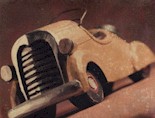
It needs to be pointed out that automotive styling wasn't always as derivative and self-referential as it is today. For example, in the late fifties, American cars sprouted exuberant rocketship fins that were as wildly different from one another as they were from anything that had been seen on cars before. Fins didn't serve any practical purpose; they were just sheet metal sculpture for its own sake.
Even in less flamboyant periods, car designers have had considerably more options than they do today. Take just one feature, the headlights: Until very recently, these could be dual or single-lamp; they could be arranged vertically, horizontally, or diagonally; they could be round or rectangular; they could be in the grille or outside of it; they could even be hidden altogether. How did we reach a point where almost all headlights must be Taurus-derived?
Another area where today's cars all copy one another is around the grille and hood.
The grilles on today's cars are a puzzlement. Not only must virtually all cars have grilles, despite the fact that they no longer typically serve much practical purpose; these must also be in a rigidly prescribed location and shape. Grilles on today's sedans must go above the bumper line, those on sports cars must go below the bumper line, and those on sort-of-sporty cars can be sort of in between. As for the grille's shape, it absolutely must be horizontal, and it must taper inward from both sides as it approaches the bumper line.
There must also be a narrow "isthmus" between the headlights and grille, painted the same color as the rest of the bodywork, so that the grille does not appear to contain the headlights.
Another odd requirement of today's automotive styling is for a pair of creases in the sheet metal of the hood, starting out relatively far apart at the windshield, then tapering down closer together at the grille. These lines trace the shape of engine covers on cars from the beginning of the automotive era through the late 1930s--i.e., in the days when hoods were separate from fenders. The point of this historical reference is apparently to establish a car's "credentials," by demonstrating its lineage back to the classics, whose longer hoods visually proclaimed power (in contrast to today's more efficiently-packaged cars, which actually have a lot more power and speed).
Such requirements may sound absurdly detailed. But a brief stroll around the new models at your local auto mall is all you need to convince yourself of their force and stringency.
What has propelled their proliferation?


